LASH LIBRARY · EYE-SHAPE STYLING
Lash mapping for hooded eyes:
a consultation guide
A hooded lid is one observation, not a preset map. Design has to work with the eye open, the natural lashes and the client’s goals.
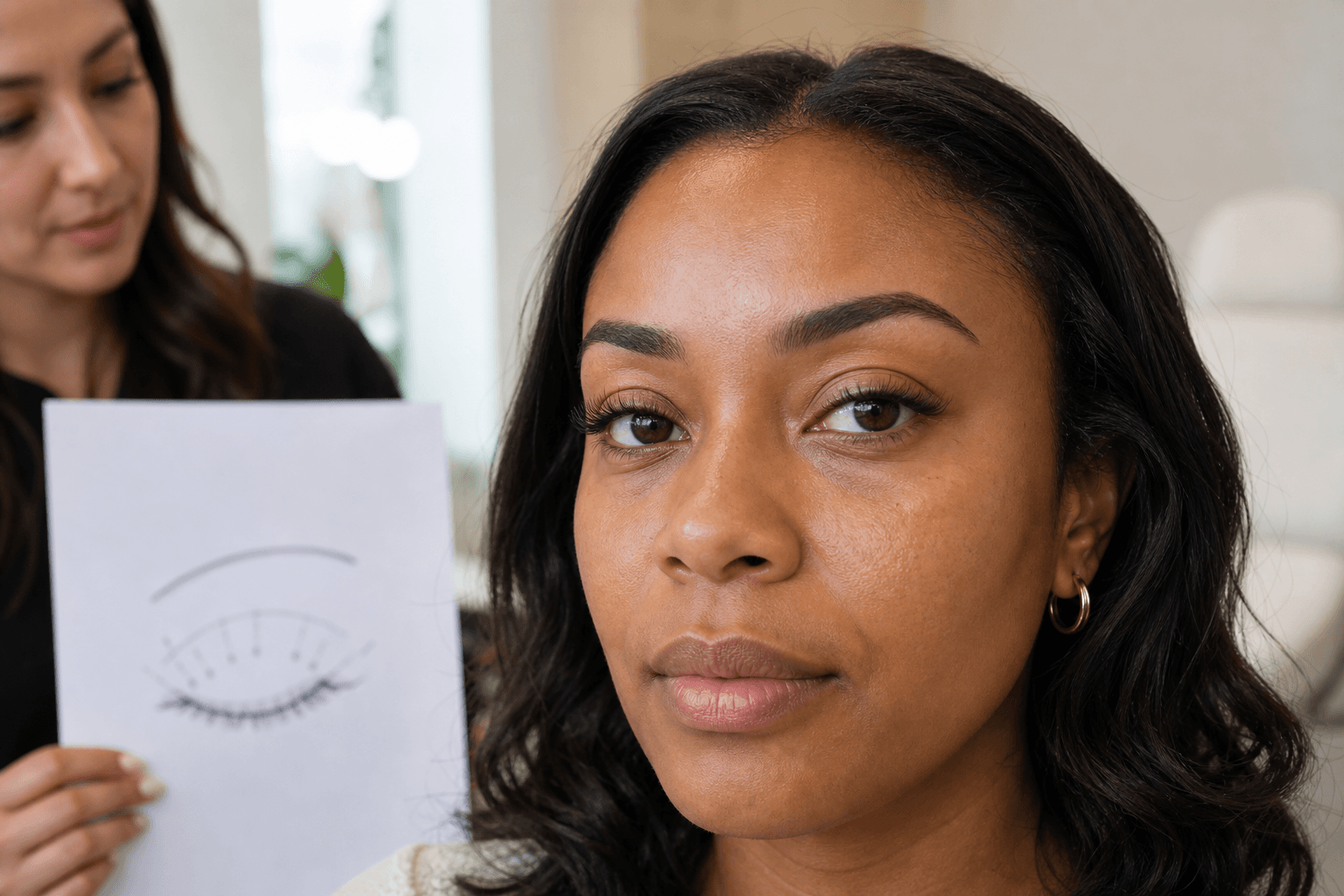
Short answer: hooded eyes do not require one “best” lash style. A thoughtful lash artist evaluates the eye open and closed, visible lid space, natural-lash direction and strength, brow clearance, eye tilt, asymmetry, glasses and your preferred level of definition before choosing curl, length, density and where the map peaks.
What “hooded” describes—and what it does not
A hooded lid has skin that folds over part of the mobile eyelid. The amount can differ between eyes and can change with expression, swelling and time. It does not reveal whether the eye is also round or almond, upturned or downturned, close-set or wide-set. It also says nothing about natural-lash strength.
That is why a photo-only verdict or a style chosen solely by age, ethnicity or face shape is too simplistic.
The six variables that matter more than a style name
- Peak position: where the longest visual emphasis sits when the eye is open.
- Curl and direction: how the extension travels away from each natural lash and whether it clears the lid comfortably.
- Length: measured against the natural lash and available lid/brow space—not copied from a chart.
- Density: how much darkness and coverage the set creates.
- Weight: what each natural lash can safely support.
- Texture: even, wispy, wet-set or softly staggered effects can change how the same outline reads.
Open-eye, kitten and softened cat-eye maps
An open-eye or doll-style map places emphasis near the center. It can create a more centered impression, but too much length or density can still crowd visible lid space. A kitten or squirrel-style map usually peaks before the outer corner and then shortens, which can preserve lift without loading the last lashes. A cat-eye map builds toward the outside; it is not forbidden, but the outer zone may need to be shorter, lighter or stepped down.
These are design families, not recipes. See our broader cat-eye, kitten and doll mapping comparison.
Curl is about clearance, not a letter contest
Online guides often prescribe one curl for every hooded eye. In practice, the same named curl can look different across brands and lengths. The artist should check the natural-lash angle and whether the extension touches the lid, brow bone or glasses through normal blinking and expression. More dramatic curl is not automatically more lifting, comfortable or appropriate.
Bring references, but describe the effect
Instead of asking an artist to copy a map exactly, explain what you like: soft definition, visible texture, a centered peak, a lifted outer third or a natural mascara effect. Reference photos are most useful when you identify the specific feature—not when you expect identical translation to another eye and lash line.
Questions to ask before application
- Can we review the proposed peak with my eyes open?
- How will you adjust for differences between my two eyes?
- What curl and length will clear my lid and glasses?
- How are density and weight matched to my natural lashes?
- Can we start conservatively and document the map for a future fill?
- What symptoms mean the set should be removed or medically assessed?
Compare construction choices in our classic, hybrid and volume lash guide.
Safety is separate from styling
A flattering map cannot eliminate adhesive exposure or eye-area risk. AAO EyeWiki describes reported complications including irritation, allergic blepharitis, corneal or conjunctival injury and traction-related lash loss. FDA advises stopping eye cosmetics when irritation occurs and avoiding them during an eye infection. California requires an appropriate license for eyelash extension services.
Postpone an appointment for active redness, swelling, discharge, pain or a current eye infection. Severe pain, light sensitivity, vision change, marked swelling or chemical exposure needs prompt eye care. Read our sensitive-eyes consultation guide if you have a reaction history.
Frequently asked questions
Can long lashes make hooded eyes look smaller?
They can create crowding on some eyes, especially with high density, but the result depends on the full map, curl, spacing and your preferred aesthetic. “Smaller” is a visual impression, not a health diagnosis.
Should inner corners be short?
They are commonly kept shorter because natural inner lashes tend to be finer and the area can feel crowded. Exact length and attachment still depend on the individual lash.
Can an artist diagnose my eye shape from a selfie?
A photo can start a style conversation, but perspective, expression and lighting distort proportions. Final mapping should be assessed in person with the eyes open and closed.
Sources and editorial note
- American Academy of Ophthalmology EyeWiki: Eyelash Extensions — checked September 1, 2026
- FDA: Eye Cosmetic Safety — checked September 1, 2026
- California Board of Barbering and Cosmetology: Eyelash and Eyebrow Services — checked September 1, 2026
- Milady: Eyelash Mapping training preview — 2022; used for professional terminology; checked September 1, 2026
Editorial note: Current search results and community discussions supplied consumer questions only. Styling suggestions are framed as consultation variables, not universal rules; medical and licensing claims rely on AAO, FDA and California Board sources.
Medical disclaimer: Educational only, not medical advice or a diagnosis.