PERMANENT MAKEUP · LONGEVITY & MAINTENANCE
How long does permanent makeup last?
“Permanent” does not mean visually unchanged.
Cosmetic tattoo pigment may soften, shift or remain visible for years. Skin, technique, color, UV exposure and prior work all make one universal expiration date misleading.
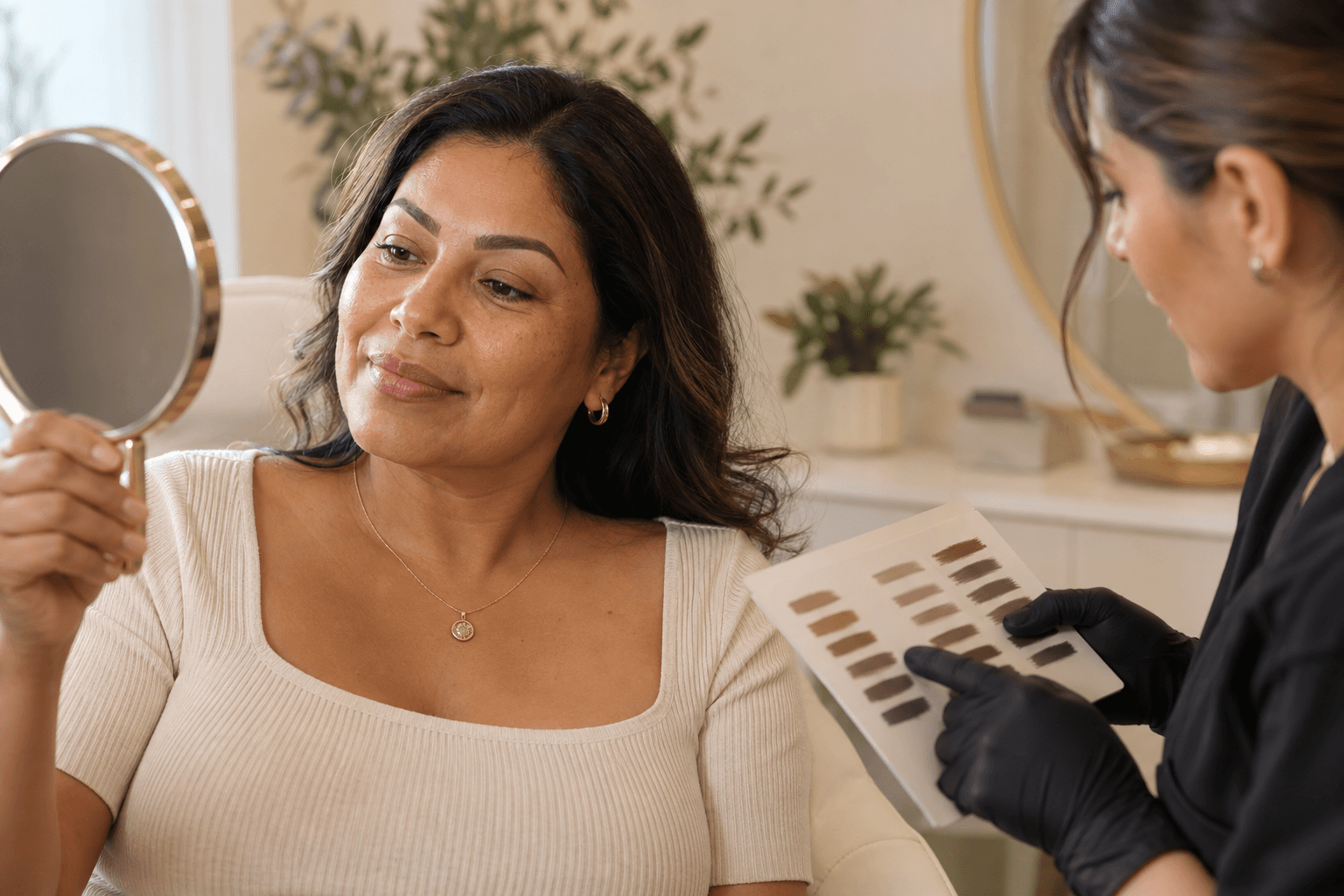
Permanent makeup does not have one dependable lifespan. It is a form of tattooing, so some pigment may remain in the skin even after the visible result softens. Published dermatology literature reports that cosmetic tattoo pigment can fade over a period of years, but an individual result cannot be assigned an expiration date before it heals.
What is permanent makeup?
Permanent makeup—also called cosmetic tattooing or micropigmentation—places pigment in the skin to create or enhance features such as brows, eyeliner or lip color. ENCLAVE currently documents permanent makeup and ombré powder brow services; this guide does not imply that every cosmetic-tattoo technique is appropriate for every client.
The FDA classifies permanent makeup as tattooing and notes that tattoos are intended to be permanent. Calling a brow service “semi-permanent” should never be interpreted as a promise that all pigment will disappear cleanly by a certain date.
Why can the visible result change?
- Pigment and color: formulas contain different color components, and they may not fade at identical rates.
- Placement and technique: depth, density, layering and the condition of prior work affect how the result heals and ages.
- Skin and healing: oiliness, inflammation, scarring tendency, medications and aftercare can change retention or candidacy.
- UV exposure: a dermatology review notes that pigment can be lost and degraded by ultraviolet light, especially on facial skin.
- Skin-care procedures: exfoliating or resurfacing treatments near the area may affect appearance and must be disclosed to both providers.
Who is it for—and what problem can it help with?
Permanent makeup may suit an adult who wants less daily brow or makeup work, more visible definition, or cosmetic camouflage and understands that the result is a tattoo. It is not a treatment for hair loss, a skin disease or an eye condition. Anyone with active irritation, infection, uncontrolled skin disease, a history of problematic scarring, or a changing lesion in the planned area needs appropriate medical guidance before a cosmetic procedure.
Does fading automatically mean it is time for a touch-up?
No. A touch-up adds pigment; it does not erase old shape, depth, migration or unwanted color. Repeatedly adding color on a calendar can oversaturate the area and make future correction more complicated. A provider should first assess the healed result in neutral light and ask whether the goal is to refresh color, adjust shape, wait, or discuss removal.
Do not book a refresh merely because a social post says “annual.” The appropriate decision depends on what is actually visible, the health of the skin, your current preferences and whether the existing work can accept more pigment safely.
A practical longevity check
- Photograph the healed result in similar natural light every few months.
- Separate normal softening from an unwanted shape or color change.
- Record the original procedure, pigments, touch-ups and any removal attempts.
- Tell the provider about retinoids, peels, laser procedures, medicines, allergies and skin changes.
- Ask what adding pigment now could mean for future fading, correction and removal.
What makes a qualified Orange County provider?
In Orange County, permanent cosmetics are regulated as body art. The Orange County Health Care Agency says artists must hold Body Art Practitioner Registration and work in a facility with a valid body-art permit. Registration and facility permitting are separate safeguards; neither is a guarantee of a particular cosmetic result.
Ask to see healed work—not only freshly finished photos—and discuss pigment records, single-use supplies, infection-control practices, informed consent, aftercare, correction limits and referral boundaries. A provider should be comfortable recommending no new pigment when existing work needs more time or a different plan.
When should a medical professional be involved?
Seek medical care for spreading redness, worsening pain, warmth, pus, fever, significant swelling, blistering, an eye symptom, or a persistent raised or itchy reaction. A dermatologist should evaluate a suspicious or changing skin lesion rather than having it tattooed over. Do not try to accelerate fading with unapproved acids, removal creams or at-home devices.
Related guidance
Review ENCLAVE’s permanent makeup aftercare guide, compare powder brows and microblading, or read the pigment-removal cost and session guide before deciding whether to add, wait or explore correction.
Sources
- U.S. FDA — Tattoos and Permanent Make-Up
- American Academy of Dermatology — Confidence Redefined: Permanent Makeup
- Journal of the American Academy of Dermatology — Permanent Makeup: Technique, Regulation and Complications
- Orange County Health Care Agency — Body Art / Permanent Makeup
Evidence note: Published ranges describe groups and techniques, not a guaranteed lifespan for one client. This article intentionally does not promise a fixed touch-up interval.
Medical disclaimer: Educational information only; not medical advice, diagnosis or a guarantee of candidacy, longevity or results.