SKIN LITERACY · ROUTINE TROUBLESHOOTING
Skin purging vs. breakout vs. irritation:
what to do next
“Purging” should not become permission to push through burning, a spreading rash or months of worsening acne.
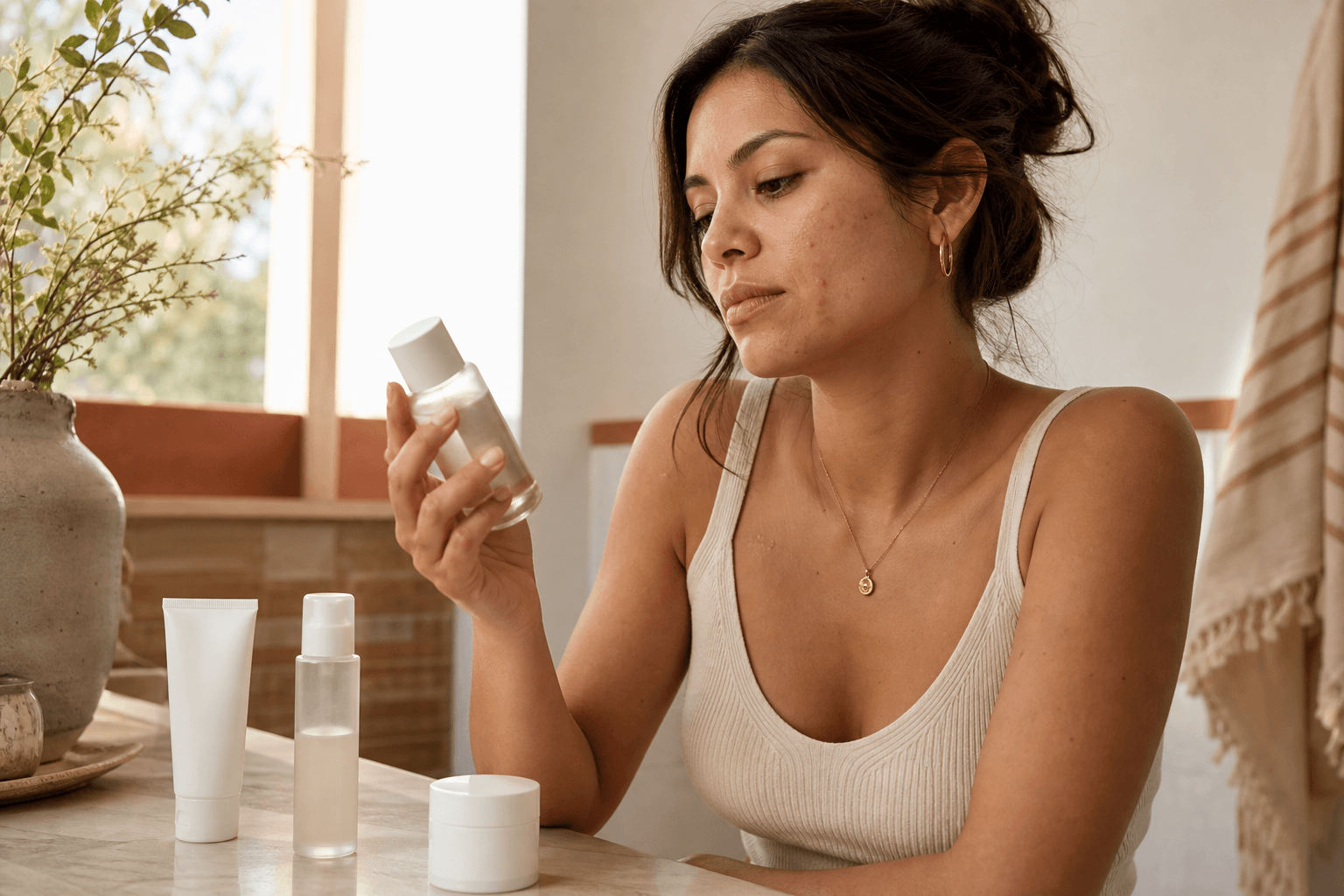
Short answer: new bumps after a retinoid or exfoliant may be described as purging, but early worsening is not guaranteed. Burning, itching, tightness, marked redness, scaling or rash-like bumps point more toward irritation. Acne can also worsen for reasons unrelated to a new product. Pattern and timing offer clues; they do not diagnose the cause.
What “purging” is supposed to mean
The popular explanation is that an ingredient which changes cell turnover makes existing microcomedones become visible sooner. Topical retinoids and exfoliating acids are the usual candidates. Yet a review of topical-retinoid trials found little evidence that a clinically meaningful initial acne flare is common. That means “everyone purges” is not evidence-based.
A few blemishes in usual acne-prone areas after starting a known acne treatment may fit the story, but continuing deterioration should trigger reassessment rather than an automatic countdown.
Irritation has its own clues
Retinoids, benzoyl peroxide and acids can cause dryness, peeling, redness, burning and stinging, especially when several are combined or used too often. The AAD notes that retinoid irritation does not automatically mean allergy and may sometimes be reduced with a gentler schedule and moisturizer.
More product is not faster treatment. A 2026 FDA label for adapalene warns that applying more than directed may worsen irritation without providing faster or better results.
A breakout is not always caused by the newest bottle
Acne changes with hormones, stress, medication, hair products, friction, occlusion and the natural course of the condition. A new rich formula may coincide with clogged pores; a new active may irritate the barrier; or the timing may be coincidence. Photos cannot reliably sort these possibilities.
Ask: What changed? When? Where are the bumps? Are they the type you usually develop? Is there discomfort or rash? Did you start several products at once?
A conservative reset
- Stop the newest nonessential product if it burns, stings or causes a spreading reaction.
- Pause extra acids, scrubs and spot treatments rather than attacking the reaction.
- Use a gentle cleanser, plain moisturizer and broad-spectrum sunscreen.
- Do not pick or squeeze; inflammation can leave post-inflammatory dark marks.
- Write down product names, start dates, frequency and symptoms.
- Ask the prescriber before changing a prescription acne plan.
When skin is comfortable again, reintroduce only one optional product at a time. Review our beginner retinoid guide, over-exfoliation guide and post-acne dark-spot guide.
When a dermatologist belongs in the plan
Seek urgent care for facial or eye swelling, trouble breathing, blistering, widespread peeling or other severe reaction. Contact a dermatologist for painful deep acne, scarring, persistent worsening, infection signs, pregnancy-related medication questions, or a reaction that does not settle after stopping the suspected irritant. A licensed esthetician can support gentle care but should not diagnose allergy, dermatitis or acne severity.
Before a facial during a flare
Tell the provider about prescriptions, retinoids, acids, recent peels and current symptoms. An aggressive peel, scrub or extensive extraction is not a universal fix for new bumps. If skin is inflamed, cracked or painful, postponing and obtaining medical guidance may be the safer plan.
Frequently asked questions
Can niacinamide or hyaluronic acid cause purging?
They are not classic cell-turnover acne treatments. New bumps may reflect the complete formula, irritation, occlusion, another routine change or unrelated acne—not proof of purging.
Does a breakout in a new area mean irritation?
It raises the question, but location alone is not diagnostic. Burning, itch, scaling and diffuse redness add concern for irritation or dermatitis.
Can a facial make acne purge?
“Purging” should not be promised as a normal benefit. Manipulation, occlusive products or excessive exfoliation can irritate skin, and active acne may require dermatologic treatment.
Sources and editorial note
- American Academy of Dermatology: Acne diagnosis and treatment — checked September 1, 2026
- American Academy of Dermatology: Retinoid or retinol? — checked September 1, 2026
- Do topical retinoids cause acne to flare? — clinical-trial review; checked September 1, 2026
- FDA-approved adapalene 0.1% label — 2026; checked September 1, 2026
Editorial note: Search results and community discussions supplied consumer questions only. Medical claims rely on official and peer-reviewed sources.
Medical disclaimer: Educational only, not medical advice or a diagnosis.