INGREDIENT LITERACY · VITAMIN C
Vitamin C can be useful.
It is not bottled daylight eraser.
Topical vitamin C has promising evidence for uneven tone and photoaging, but formulation, stability, tolerance, time, and sun protection shape the result.
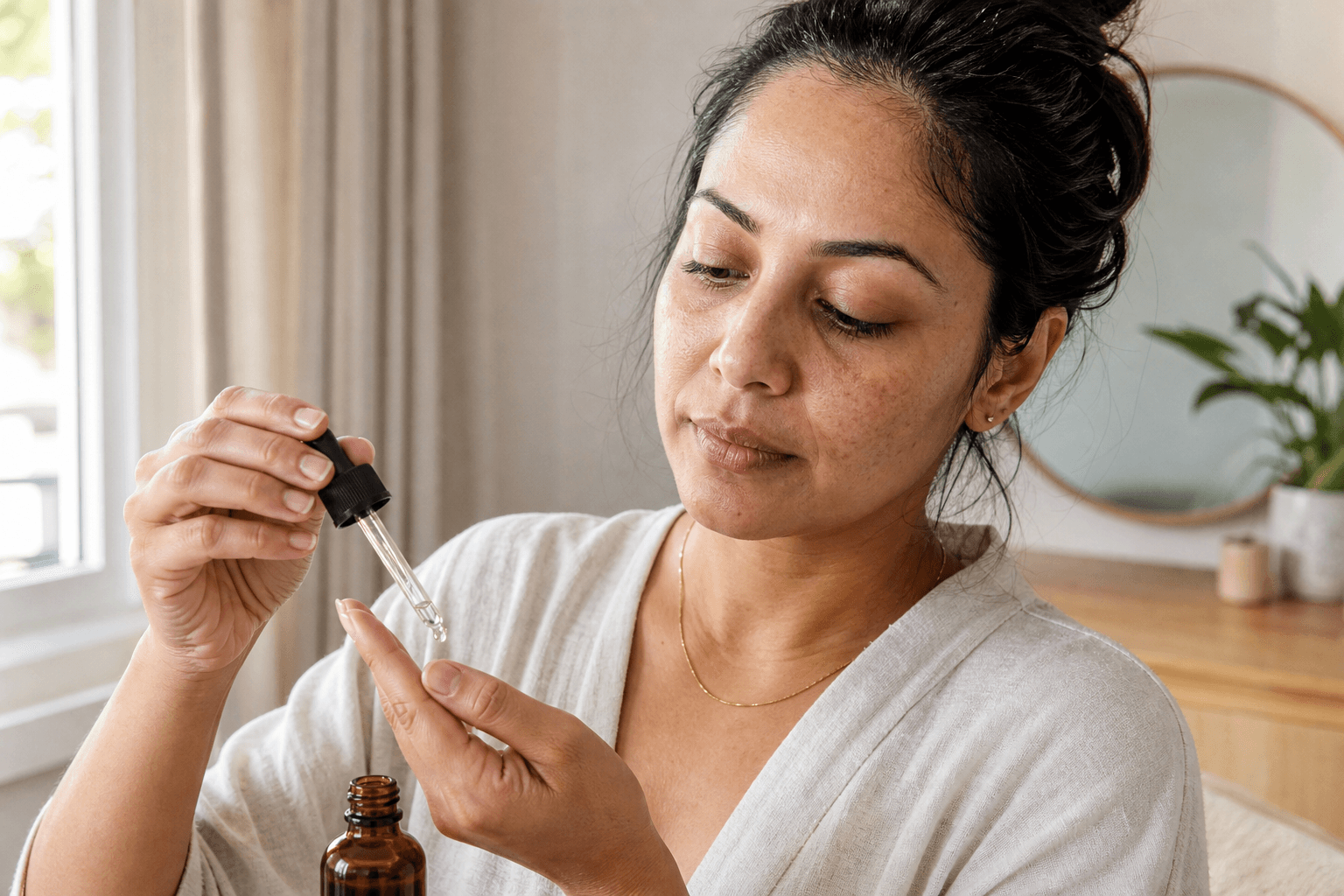
“Vitamin C” on a label can mean L-ascorbic acid or one of several derivatives in different concentrations, pH ranges, vehicles, and packages. Two products with the same headline ingredient may not behave the same way on skin.
What the evidence suggests
A 2023 systematic review found seven controlled publications with only 139 volunteers. Treated skin showed improvement in uneven pigmentation, surface smoothness, and wrinkles, but the authors concluded that longer use may be needed and more research is necessary to define an ideal concentration. That is encouraging evidence—not proof that every serum or every dark spot will respond.
Vitamin C is not sunscreen
Antioxidant activity does not replace labeled sun protection. In sunny routines around Santa Ana and Orange County, apply broad-spectrum sunscreen as directed and use shade, clothing, hats, and sunglasses. The American Academy of Dermatology suggests applying vitamin C after morning cleansing and before sunscreen.
Form matters
L-ascorbic acid is well studied but chemically unstable and can be irritating in acidic formulas. Derivatives are designed to improve stability, delivery, or tolerability, yet their conversion and clinical evidence vary. Avoid assuming that a higher percentage or unfamiliar derivative is automatically stronger or better.
Color and smell can signal change
Ascorbic acid can degrade with light, oxygen, water, heat, pH, and formulation conditions. Store the product exactly as directed, close it promptly, and avoid touching the dropper to skin. If color, odor, or texture changes beyond the manufacturer’s description, ask the company whether it should be discarded rather than relying on a social-media color chart.
Introduce it slowly
Patch-test a new product on a small area and add only one new active at a time. Start less frequently if the label permits. Burning, persistent redness, swelling, hives, or worsening dermatitis is not a sign that a product is “working.” Stop and seek medical guidance for a significant or lasting reaction.
Do not stack irritation
Using vitamin C beside retinoids, exfoliating acids, benzoyl peroxide, scrubs, peels, or procedures may overwhelm sensitive skin even when each item is acceptable alone. Separate changes so you can identify the cause of irritation. Prescription routines belong with the prescriber.
Know what a dark spot might be
Vitamin C may support care for some uneven pigmentation, but it cannot diagnose melasma, post-inflammatory hyperpigmentation, a medication reaction, or a changing lesion. A spot that evolves, bleeds, becomes painful, looks unlike the others, or does not heal needs a dermatologist rather than a brightening experiment.
Before a facial or peel
Tell the provider which vitamin C product and other actives you use, how often, and whether skin stings or flakes. Postpone exfoliating services on irritated, sunburned, open, or infected skin. A consultation should protect the barrier instead of layering a stronger treatment onto an active reaction.
Sources and editorial note
- Efficacy of Topical Vitamin C in Melasma and Photoaging: A Systematic Review — 2023
- A Review of Topical Vitamin C Derivatives and Their Efficacy — 2022
- American Academy of Dermatology: Science-Backed Skin Care
- Stabilization Engineering of Ascorbic Acid — 2024
Editorial note: Reviewed August 31, 2026. Evidence for an ingredient does not validate every commercial formulation or claim.
Medical disclaimer: Educational only, not medical advice or a diagnosis.