SENSITIVE SKIN · PRODUCT SAFETY
Before it goes on your face,
give it a smaller introduction.
“Sensitive skin,” “clean,” and “hypoallergenic” do not guarantee that a product will suit you. A small-area trial can reveal some problems before full-face use—but it is not the same as medical patch testing.
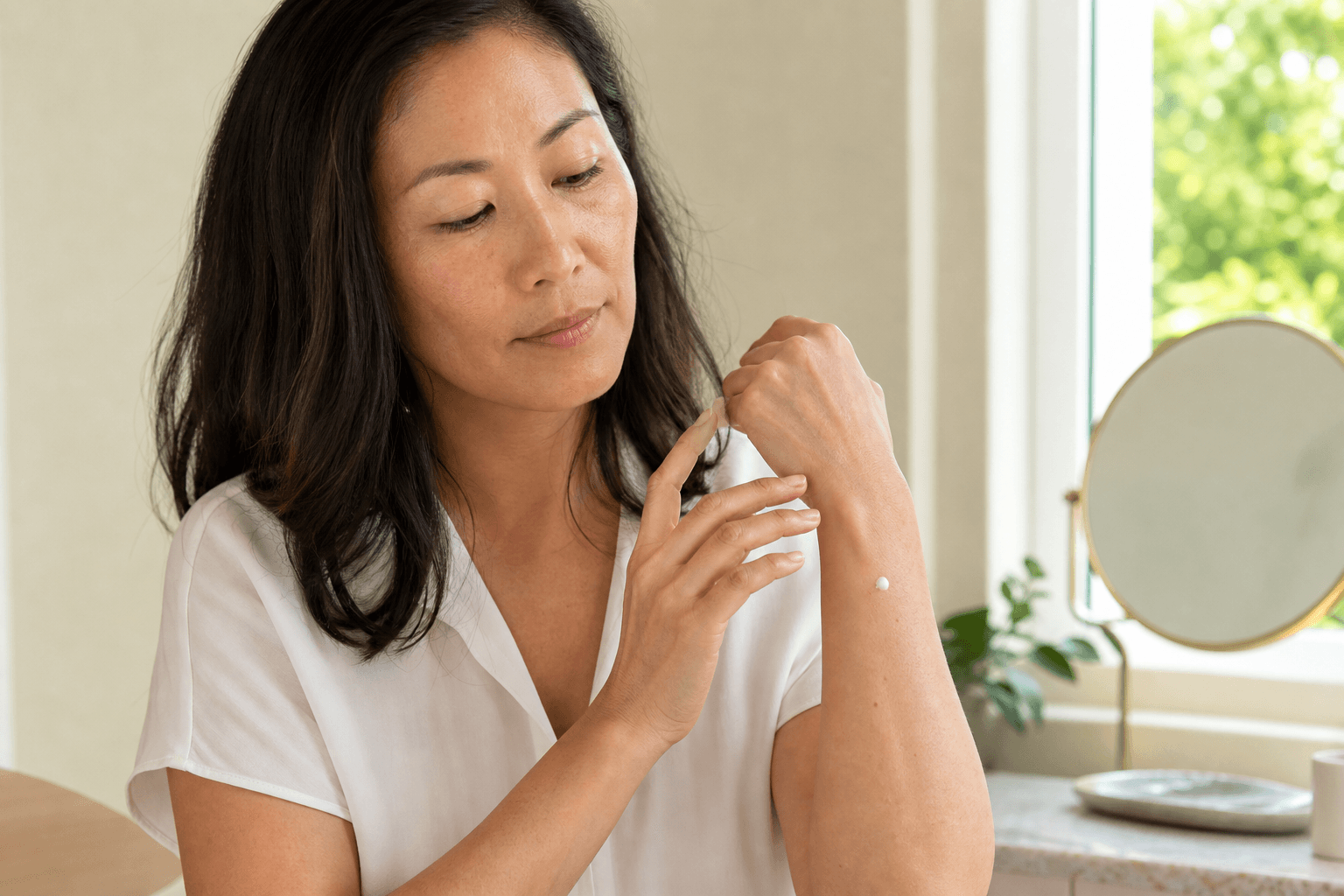
A reaction can happen even when a product is expensive, botanical, fragrance-free, or made for sensitive skin. Irritant contact dermatitis and allergic contact dermatitis are not identical, and a home trial cannot diagnose either one. It is simply a cautious screening step.
AAD’s small-area testing method
The American Academy of Dermatology recommends applying the product to a quarter-sized area on the underside of the arm or bend of the elbow twice daily for seven to ten days. Use the normal amount and leave it on for the usual time. For a wash-off cleanser, follow the label’s contact time rather than leaving it on all day.
If redness, itching, swelling, burning, or another reaction develops, wash the product off gently and stop using it. A cool compress or plain petroleum jelly may offer comfort for a mild reaction, while severe or persistent symptoms need a dermatologist.
Do not test five new products together
Introduce one product at a time. Starting a cleanser, serum, exfoliant, moisturizer, mask, and sunscreen on the same day makes it difficult to identify the cause of a reaction. Keep the packaging and photograph the ingredient list and lot information in case you need to discuss the event with a clinician or report it.
Read beyond the front label
The FDA notes that cosmetics may contain allergens from fragrance, preservatives, dyes, metals, or natural rubber. Terms such as “hypoallergenic” and “for sensitive skin” do not create a federal guarantee that a reaction cannot occur. Review the full ingredient panel, avoid known allergens, follow the manufacturer’s directions, and contact the company when ingredient information is unclear.
Irritation is not automatically an allergy
Retinoids, acids, benzoyl peroxide, and other actives can irritate skin, especially when started too often or combined. Allergic contact dermatitis may be itchy, red, swollen, or blistered and can appear hours or days after exposure. Appearance alone may not identify the cause. Recurrent facial, eyelid, lip, neck, or hand dermatitis belongs with a qualified clinician.
Home testing is not medical patch testing
Medical patch testing is a clinician-supervised diagnostic process that places measured allergens on the skin and requires follow-up readings. It is different from a skin-prick test and from trying a finished cosmetic on your arm. A 2026 clinical review describes diagnostic patch testing as the standard for identifying allergic contact dermatitis, while noting that personal-care products can contain both established and emerging allergens.
Plan around facials and permanent makeup
Do not introduce a new active immediately before a facial, peel, brow service, lash service, or permanent makeup appointment. If a reaction develops, postpone the service until skin is intact and calm. Tell the provider about recent products, prescriptions, allergies, prior adhesive or dye reactions, and current irritation. Around Santa Ana and Orange County, also allow recovery time before outdoor events with significant sun exposure.
When to get urgent help
Facial, lip, tongue, or throat swelling; trouble breathing or swallowing; wheezing; faintness; or rapidly worsening widespread hives can signal a severe reaction. Seek emergency care. For a persistent rash, blistering, significant eye involvement, pain, infection signs, or symptoms that recur with cosmetics, contact a qualified clinician.
Sources and editorial note
- American Academy of Dermatology: How to Test Skin-Care Products — updated 2021
- U.S. FDA: Allergens in Cosmetics — updated 2024
- Allergic Contact Dermatitis to Personal Care Products — Journal of the American Academy of Dermatology, 2026
- AAD: Patch Testing Can Find What Is Causing Your Rash
Editorial note: Reviewed August 30, 2026. The at-home method described here screens a finished product on a small area; it does not diagnose an allergy.
Medical disclaimer: This article is educational and not medical advice or a diagnosis. Enclave Beauty services do not replace licensed medical care.