TATTOO SAFETY · LASER HAIR REMOVAL
Can you do laser hair removal over a tattoo?
Do not treat the inked skin.
Hair-removal lasers and IPL are designed to send light into pigment. Tattoo ink is pigment too, so a pulse meant for a hair follicle may also heat the tattoo.
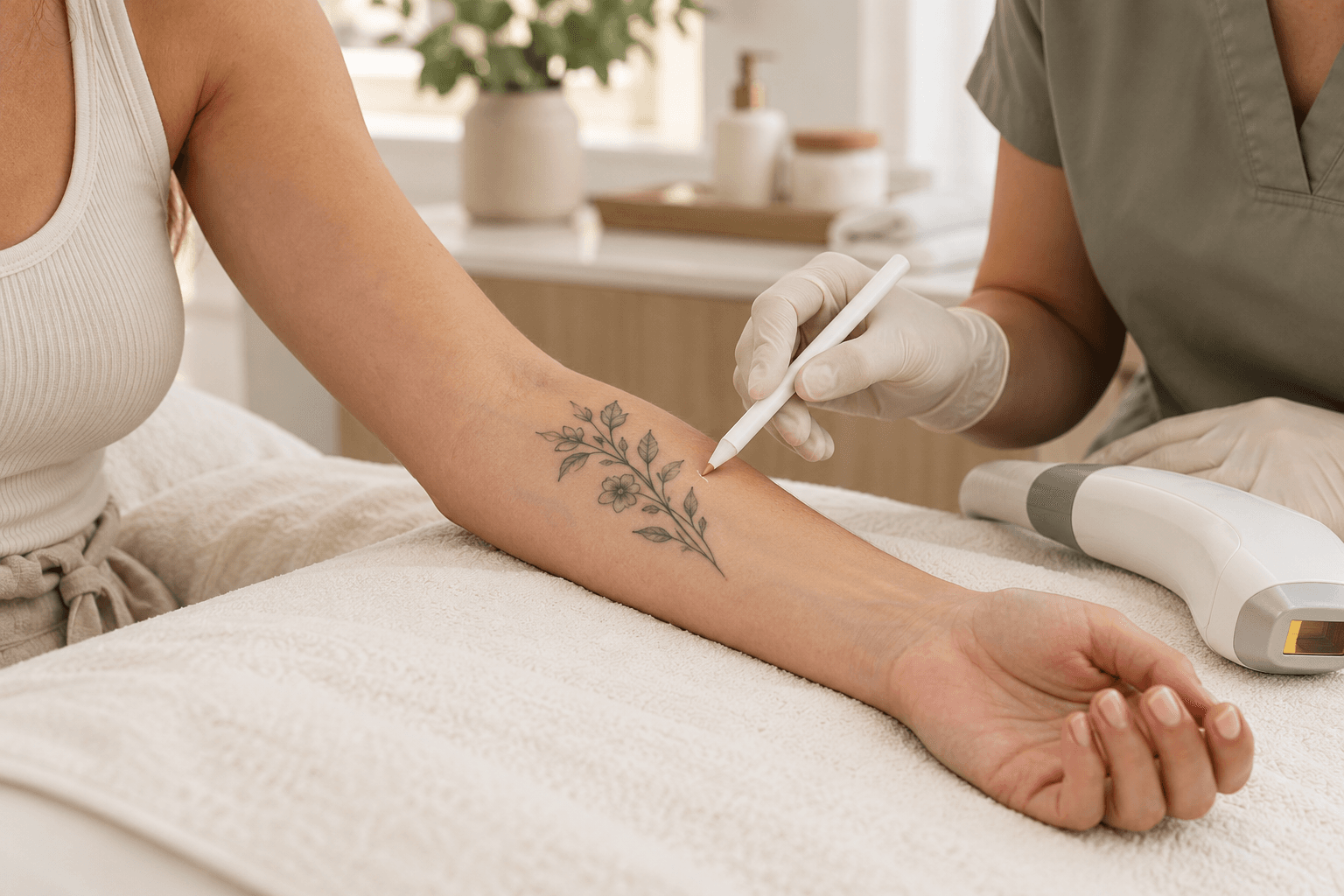
No—laser or IPL hair removal should not be fired directly over tattooed skin. Published safety guidance advises avoiding hair-removal treatment where a tattoo is present because tattoo pigment can absorb light, creating a risk of burns, pigment change, scarring or unwanted fading. Hair around the tattoo may still be treatable, but the provider must plan and protect the exclusion area according to the device instructions and your skin.
Why can a hair-removal device react with tattoo ink?
Laser and intense pulsed light hair removal rely on selective heating: light is absorbed by pigment associated with the hair and converted to heat. A tattoo introduces additional pigment in the skin. Safety guidance from the European Society for Laser Dermatology explains that this can divert energy into the ink instead of only the intended hair target.
This does not mean every accidental pulse causes the same injury. Ink color and depth, skin tone, device wavelength, pulse duration, energy, spot size and cooling all matter. It does mean a tattoo is not a safe place to improvise or “turn the setting down” without device-specific clinical guidance.
THE PRACTICAL RULE
Map first. Treat around—never through—the tattoo.
A qualified provider should see the tattoo before treatment, explain the no-treatment boundary and tell you how accidental exposure will be prevented. A patch test on the tattoo is not a safe workaround.
Who needs this warning most?
- Anyone planning laser or IPL hair removal on a tattooed arm, leg, back, chest, bikini line or face.
- People with cosmetic tattoos or permanent makeup near a proposed treatment area.
- Anyone using a home light-based hair-removal device.
- People planning a new tattoo while already in a hair-removal series.
- Anyone whose tattoo was accidentally pulsed and now feels unusually hot, painful or swollen.
Do / Don’t checklist before the appointment
Do:
- Show every tattoo and permanent-makeup area during the consultation, including small, faded or flesh-colored ink.
- Ask how the provider marks and protects the exclusion zone.
- Ask which device is being used, who operates it and what training applies to your skin tone.
- Tell the provider about a tendency to scar, keloids, recent tanning, skin conditions and all medicines.
- Follow the device-specific preparation instructions for the skin that can be treated.
Don’t:
- Cover a tattoo yourself and assume that makes direct treatment safe.
- Ask for “one quick pass” over the ink or use the tattoo as a test spot.
- Use a home laser or IPL over a tattoo when the manual excludes tattooed skin.
- Treat irritated, sunburned, infected, newly tattooed or incompletely healed skin.
- Assume an old or faded tattoo no longer contains light-absorbing pigment.
Can the hair around a tattoo still be treated?
Potentially, yes. The surrounding uninked skin may be eligible after an individualized assessment. There is no universal online measurement for how close a device may safely pass: the necessary margin depends on the spot size, device design, tattoo edge and provider protocol. Ask the provider to show you the planned border before the first pulse.
Hair growing directly through tattooed skin may need a non-light-based approach. Shaving or trimming may be options for some people. Electrolysis is a different procedure, but candidacy and timing still require a qualified practitioner; this article does not declare it safe for every tattoo or every person.
What if you want both hair removal and a new tattoo?
Plan the sequence before either procedure. If hair reduction over that exact skin matters, discuss it before placing permanent ink. If the tattoo already exists, do not start removing or altering it solely to make hair removal possible without a separate, informed tattoo-removal consultation. Tattoo removal is a multi-session process and complete clearance is not guaranteed.
What can go wrong after an accidental pulse?
A published case report described a second-degree burn within a tattoo after IPL epilation. A single case cannot predict how often this happens, but it supports the physical concern described in broader safety guidance. Possible signs include immediate sharp heat or pain, whitening or darkening of ink, swelling, blistering, crusting, an open wound or later pigment change.
What should you do if the tattoo was accidentally hit?
- Tell the operator immediately and stop treatment over and near the area.
- Follow written aftercare from the treating clinician or qualified provider; do not apply acids, bleaching products or unapproved numbing creams.
- Photograph the area in consistent light and document the device, time and symptoms.
- Seek prompt licensed medical care for worsening pain, large or spreading blisters, an open wound, spreading redness, increasing warmth, pus, fever or red streaks.
- Call emergency services for trouble breathing, faintness, rapidly spreading swelling or other signs of a severe reaction.
Seven questions that reveal a careful provider
- How will you identify every tattoo and permanent-makeup area?
- How does this device’s manufacturer say tattooed skin should be handled?
- What exclusion border will you use, and why?
- How will you protect the tattoo from an accidental pulse?
- What experience do you have with my skin tone and this body area?
- What symptoms are expected, and which need medical care?
- What alternative can address hair growing inside the tattooed area?
How this relates to ENCLAVE
ENCLAVE’s documented service is tattoo and unwanted-pigment removal—not laser hair removal. This guide helps Orange County clients coordinate care and avoid a preventable laser mistake when a tattoo, permanent makeup or future removal plan is involved.
Related guidance
Start with the tattoo and pigment removal overview, understand cost and session variables, compare fading for a cover-up versus fuller removal, and review aftercare and healing signs.
Sources
- American Academy of Dermatology — Laser hair removal: Preparation (accessed October 9, 2026; consultation, risk and preparation guidance)
- Riml et al., 2013 — Second-degree burn within a tattoo after intense-pulsed-light epilation (case report; does not estimate frequency)
- European Society for Laser Dermatology consensus group — Guidelines on the safety of light-based home-use hair removal devices (2012; tattoo-specific mechanism and avoidance guidance)
- U.S. FDA — Tattoo Removal: Options and Results (accessed October 9, 2026; tattoo pigment, laser selection and removal limitations)
Evidence note: The tattoo-specific warning is supported by consensus safety guidance and a case report. Evidence does not provide one universal safety margin for every device, tattoo and person.
Medical disclaimer: Educational information only; not medical advice, diagnosis or a guarantee of candidacy, safety or results.